Three years ago, I stumbled onto a math framework that had nothing to do with my content area and everything to do with the kind of classrooms I wanted to help build. I didn’t know it at the time, but Peter Liljedahl’s Building Thinking Classrooms (BTC) would end up reshaping not only how I teach, but how I plan, listen, and learn alongside students. What began as a curiosity quickly became a series of experiments—first with a handful of seniors, then with a full ninth‑grade ELA class, and eventually with students fighting for a diploma. This is the story of how BTC moved from “interesting idea” to essential practice in my work as a literacy coach and teacher.
First Experiments
I started where most curious teachers start: I went online, looking for people who were already trying it. I joined several BTC Facebook groups and began learning how others facilitated random groups and designed non‑curricular thinking tasks. When a small group of students came to me for test‑prep and remediation, it felt like the perfect low‑stakes place to experiment.
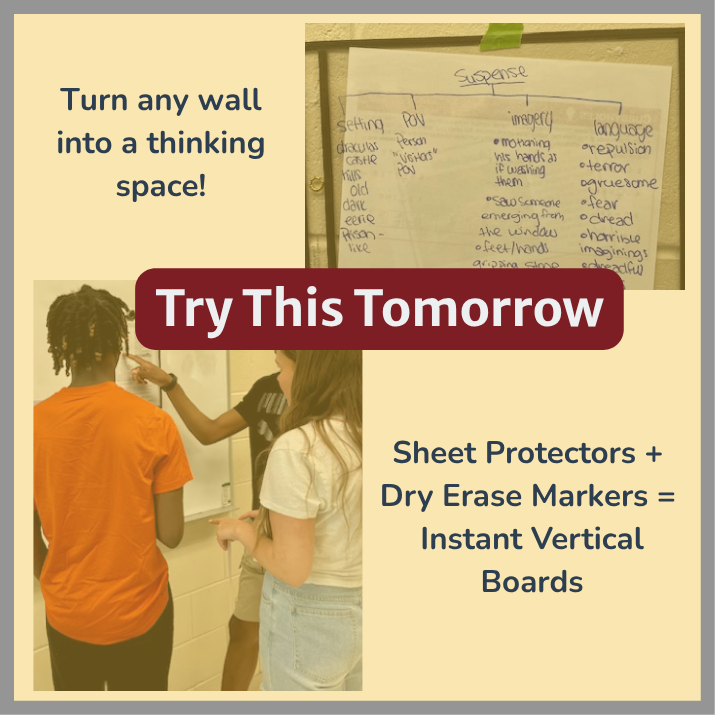
Using shop‑ticket holders as vertical non‑permanent workstations, I reimagined SAT practice items as thinking tasks rather than answer‑finding exercises. We opened with quick word‑game warm‑ups, moved into random‑group vertical‑board work on passages, and closed with individual SAT items where students revisited questions, explained how they eliminated distractors, and compared reasoning in brief gallery walks.
By the end of the spring, all of the seniors passed. I couldn’t say BTC was the only reason, but I could see how standing up, thinking together, and taking risks shifted their engagement. I had a sense of what was possible—and I wasn’t done experimenting.
Trying BTC in a Full ELA Classroom
Those early experiments gave me confidence, but I still didn’t feel ready to coach teachers on using these strategies in full classrooms. That changed when our school transitioned to mixed‑ability 9th‑grade ELA classes, and I picked up a single class of twenty‑five students pulled from multiple classes. I was ecstatic. Not only did I get to teach again, but to finally see whether BTC could hold up in a real, full classroom.
Students quickly learned that when the PickerWheel appeared, they wouldn’t be staying in their seats. Following Liljedahl’s advice, groups were always formed publicly, and I honored them, even when certain pairings drew groans or cheers. Students began to see each other differently: the quiet student who rarely spoke in whole‑class discussions might be the first to spot a pattern; the student who struggled with writing might emerge as a strong verbal thinker or facilitator. Roles shifted constantly, and that was the point.
What surprised me most was how quickly the class became a community. Random grouping removed the social choreography that often slows relationship‑building, and thinking together gave students a reason to trust one another. The room grew louder—and more focused. Students took risks more freely because they recognized that everyone had something to contribute.
Not every lesson went smoothly. Timing fell apart. I worried about “covering enough.” But there were also moments—like a lesson on Anthem, where every group arrived at a defensible interpretation through a different path—when I knew I was seeing deeper thinking than in more traditional setups.
What FAST Scores Could–and Couldn’t–Tell Me
And while those moments told me a lot, I also had something more concrete to look at. End-of–the-year FAST scores gave me one kind of information, but the classroom gave me another. Not every student reached grade level, and I didn’t expect them to—not in a single year, and not through one instructional shift.
But I watched students who had struggled to participate suddenly take intellectual risks at the boards. I watched groups defend interpretations with evidence they had found together. Some students’ scores rose, others held steady, but all of them were thinking more deeply than they had in September. And that, to me, was the real measure of progress.
By then, I was well‑versed in the benefits of random grouping, non‑curricular thinking tasks, and vertical non‑permanent workstations. I began helping teachers across my school try these strategies in their own classes. But I also knew there was more in Liljedahl’s work I hadn’t yet explored.
Returning to Seniors: Thin-Slicing Changes Everything
Then came another unexpected opportunity to stretch my practice. In January, I started teaching 11 seniors who still needed to pass a graduation‑required math test, and from day one, I committed to the same BTC routines. Because the course was labeled “remediation,” I often opened with a brief warm‑up—reviewing something like solving for 𝑥, before sending students to the boards to work through test‑aligned problems together.
As students passed the tests they needed, the group shrank. With six students remaining, it became clear that revisiting surface‑level strategies wasn’t enough; we needed to rebuild some foundational understanding. I’d seen thin‑slicing mentioned again and again in the BTC spaces I follow, but it wasn’t until this point that I was ready to slow down and learn what it truly involved.
Thin‑slicing—breaking down required skills into a sequence of tiny, increasingly complex steps—became the missing piece. I’m not a math teacher, and I don’t always know the progression of skills hidden inside a test problem, so I asked my AI friend, Copilot, to help me break questions into smaller, intentional steps. It wasn’t perfect on the first try, but through collaboration, we built some genuinely effective lessons.
The results were transformative. In a work‑rate problem, we began with something deceptively simple: converting minutes into fractions or decimals of an hour. It wasn’t difficult, but it was essential—and for the first time, I could see exactly why later steps so often fell apart.
In another lesson on area, the thin‑sliced progression revealed the logic behind formulas I had memorized years ago but never truly understood. Suddenly, the formula for the area of a triangle wasn’t just ½𝑏ℎ; it made sense. The whole room buzzed as students realized a rectangle was just two triangles.
With two months left and six seniors still working toward their goal, thin‑slicing feels like the missing piece—and a reminder that BTC continues to change not just how my students learn, but how I do, too.
I even tried thin-slicing an SAT grammar question on subject-verb agreement and was amazed at how much more accessible the actual SAT items became after students worked through a logical progression of increasing-difficulty.
Three Years Later: What I Know Now
What began as a curiosity has become a throughline in my work. Across grade levels and content areas, the same truth keeps emerging: when students think together, they learn together. And when teachers create the conditions for that thinking, classrooms become places where every learner has something to contribute.
That’s the work I want to keep doing, and the work I hope more teachers will explore.
 Julie Conlon
Leave a comment