Last week, something small but important happened in a 9th-grade ELA class.
I’m currently helping facilitate a book club rotation model in a co-taught ELA classroom (general ed + ESE). With FAST testing approaching, we planned a tight structure: three dystopian novels, three rotating stations (test prep, book club discussion, and independent reading). Tuesdays through Thursdays are rotations; Mondays and Fridays are whole-group. On Tuesdays, during two class periods, the ESE teacher pushes into another classroom, so I run the Fahrenheit 451 book club. Each week, the discussion centers around worksheets created by the 9th-grade PLC. This week’s topic was “Making Connections.”
The Problem (You’ve Seen This Before)
My 6th period group hadn’t read very far. Not even close to where they were supposed to be. You’ve seen this moment. The averted eyes. The shoulder shrugs. The quiet dread.
I could have:
- Pressed harder on the worksheet
- Redirected the conversation back to “What you should have read”
- Turned it into quiet catch-up time
Instead, I paused. If they weren’t reading yet, forcing a product wasn’t going to make them start. It might have made some of them copy someone else’s work or skim the Spark Notes, but most don’t care enough to even do that. So I went off script. Sort of.
The Decision: Let’s Just Talk About the Book
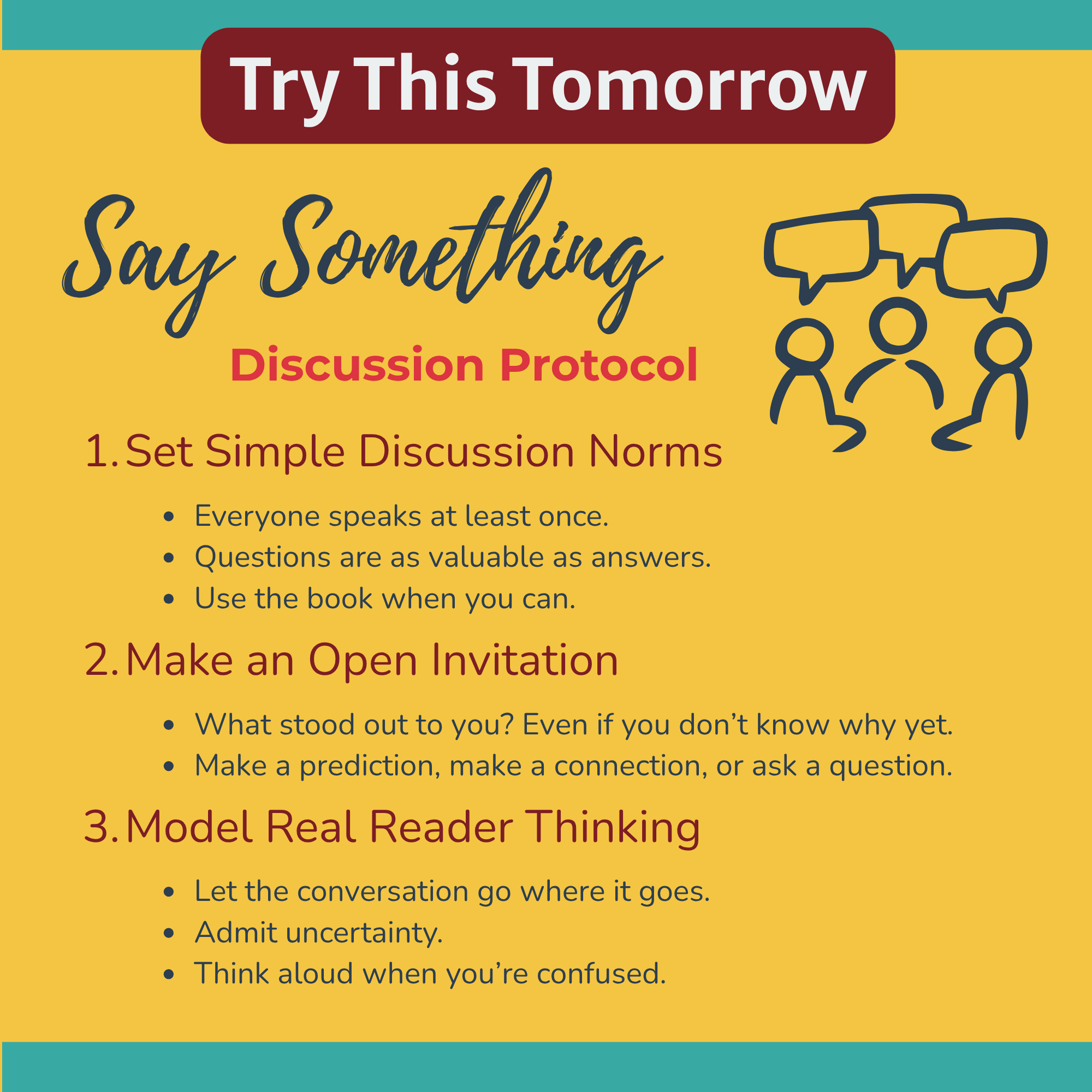
We began with a quick reset: What are connections? Why do readers make them? How do they help us understand a text better?
Then I told them this:
“We’re just going to talk about the book today. You can ask questions, make connections, make predictions—whatever you want based on whatever you’ve read so far—but everyone says something. Who wants to go first?”
We talked the entire period. When we weren’t sure, we flipped back through the text together to try to find out. Do the houses themselves burn down? (Page 6) Why does Beatty seem to know so much about books? (Page 59) Does the robot dog sniff out the books? (Page 22)
We made observations. We questioned contradictions. We lingered. We noticed things that don’t fit neatly on a worksheet.
Someone compared the seashells to AirPods. That led to a conversation about:
- What it feels like to talk to someone who has AirPods in
- Whether Montag might feel the same way talking to Mildred
- What that says about attention, connection, and isolation
Someone predicted that Montag would get caught. This led to more questions about motives and friendship and freedom–both in the book and in real life.
They discovered the pictures and supplementary materials at the back of the anniversary edition, content they might never have noticed if we hadn’t slowed down enough to just be with the book.
What I Noticed
The students hadn’t read much going in. But by the end of the period, they were referencing the text voluntarily and asking their own questions. They were curious—about characters, about motives, about what would happen next
They weren’t completing a worksheet. They were thinking.
Watching them talk their way into the book made me realize something I should have known already.
The Regret (and the Realization)
My only regret is that this conversation didn’t happen in Week One or Two, when I was still focused on getting the pages read and the worksheet done. But maybe that’s the lesson. Sometimes our students don’t need tighter accountability. They need an invitation.
And maybe we do too. In classrooms ruled by pacing guides and test dates, it’s easy to forget that curiosity is often our best teaching tool. The connections they made between Bradbury’s seashells, parlor walls, and authoritarian governments might be enough to get some of them to read a little farther tonight.
Maybe it’s enough to get us back to the kind of teaching that made us want to be English teachers in the first place.


Leave a comment